
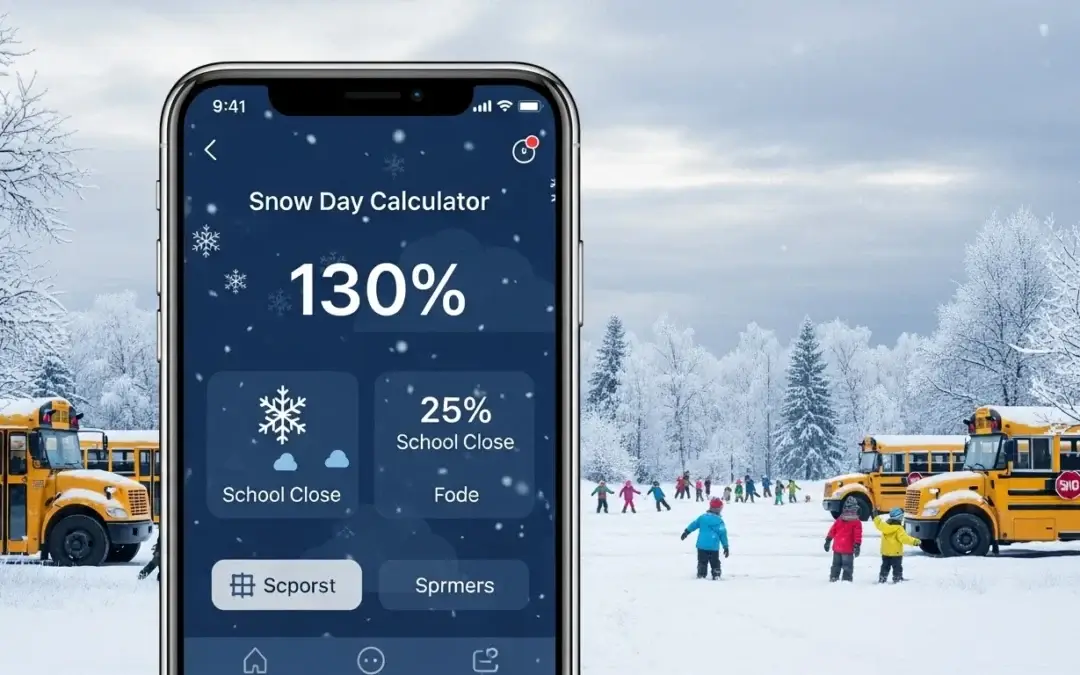
Every student knows that feeling. You wake up early, look outside at a blanket of snow, and immediately grab your phone hoping school is cancelled. But instead of waiting nervously for an official announcement, what if you could predict a snow day before anyone else does?
That’s exactly what a Snow Day Calculator is designed to do. It’s an online tool that uses local weather data, historical school closure patterns, and real-time forecasts to estimate the probability of your school cancelling classes due to snow or winter weather conditions.
In this guide, we’ve put together 10 powerful facts every student, parent, and educator needs to know about the Snow Day Calculator. From how accurate it actually is to which version works best for college students, this article covers everything worth knowing.
Snow Day Calculator and How Does It Work
A Snow Day Calculator is a web-based or app-based prediction tool that estimates the likelihood of a school or college cancelling classes because of winter weather. It pulls data from weather forecasting services, cross-references historical closure patterns for your specific region, and outputs a percentage chance that your institution will call a snow day. The concept sounds simple, but the data processing behind a good snow day predictor is genuinely more complex than most users realize.
The original and most widely used Snow Day Calculator was created by David Sukhin, a developer who built the tool as a teenager and has continued improving it over the years. The tool became enormously popular in the northeastern United States before spreading to users across the country and internationally. Today it serves millions of requests every winter season from students, parents, and teachers who want an early heads-up before official announcements come through. Understanding how the tool actually generates its predictions helps you use it more intelligently and interpret its results more accurately.
Facts Every Student Needs to know about this calculator
1: The Snow Day Calculator Uses Real Weather Data
The foundation of every Snow Day Calculator prediction is real weather data pulled from established meteorological sources. The tool doesn’t guess based on a quick glance at the forecast. It ingests data points including expected snowfall totals, precipitation timing, temperature ranges, wind speed, and road condition projections to build its probability estimate. The more precisely these inputs reflect conditions in your specific location, the more useful the output becomes.
Most versions of the snow day calculator school tool pull forecast data from sources like the National Weather Service, AccuWeather, and other established weather APIs. The fox 8 snow day calculator, for instance, is a regional variation that incorporates localized forecast data specific to the areas its news station covers. This reliance on professional meteorological data gives the tool a meaningful accuracy advantage over simply eyeballing a weather app and making your own guess about whether school will be cancelled.
2: Snow Day Calculator Accuracy Is Surprisingly High
One of the most common questions people ask before trusting this tool is how accurate is snow day calculator really. The honest answer is that it performs better than most people expect, particularly for school-level predictions in regions with well-documented historical closure data. Independent assessments and user feedback consistently suggest accuracy rates in the 70 to 80 percent range for short-range predictions, meaning forecasts for the next day or the following morning.
Snow day calculator accuracy drops when you extend the prediction window beyond 48 hours because weather forecasting itself becomes less reliable at that range. The tool is at its most dependable when you’re checking the snow day calculator for tomorrow using a forecast that was updated within the last few hours. For Monday predictions checked on Friday or Saturday, the accuracy understandably drops because snowfall totals and timing can shift considerably over a weekend. The key takeaway is that this tool is genuinely useful as a probability guide, not a guaranteed answer, and treating it that way leads to the most realistic expectations.
3: It Works Differently for Schools and Colleges
There’s an important distinction between how the Snow Day Calculator performs for K-12 schools versus college and university predictions. Elementary and high schools tend to follow more predictable closure patterns because they’re governed by district-level decisions that account for student transportation across wide geographic areas including bus routes that cover rural roads where conditions deteriorate faster. This makes K-12 predictions more consistent and reliable across different regions.
The college snow day calculator presents a different challenge. Universities and colleges rarely cancel entire days of classes. Instead, they more commonly delay openings, cancel individual classes at the professor’s discretion, or shift to remote instruction. This means the snow day calculator college function outputs need to be interpreted differently. A high percentage doesn’t necessarily mean the whole campus shuts down. It might mean there’s a strong chance of significant disruptions. For college students specifically, the tool is most valuable as a trigger to check official university communications rather than as a definitive closure predictor.
4: Location Makes a Big Difference in Predictions
Where you live has an enormous impact on how useful and accurate your Snow Day Calculator results will be. Schools in regions that regularly experience heavy winter weather, like the Great Lakes area, New England, and the upper Midwest, have extensive historical closure data that the tool can reference. The snow day calculator Michigan predictions, for example, tend to be particularly well-calibrated because Michigan schools have long track records of closure decisions under a wide range of winter weather conditions.
In contrast, schools in southern states or regions that rarely see significant snow operate very differently. A school district in Georgia or Tennessee may cancel classes for two inches of snow that a Michigan or Minnesota school would consider barely worth mentioning. The Snow Day Calculator accounts for this regional sensitivity by factoring in local thresholds alongside raw weather data. If you’ve ever noticed that your predictions seem off compared to someone in a different state using the same tool, regional calibration differences are almost certainly the explanation.
5: The AI-Powered Version Is a Game Changer
The most significant development in snow day prediction in recent years has been the introduction of AI-powered versions of the tool. The snow day calculator AI builds on the traditional weather data inputs by adding machine learning layers that analyze patterns across thousands of historical closure decisions to identify correlations that simpler formula-based tools miss entirely.
AI versions can factor in variables like the day of the week, proximity to holidays or testing periods, local school district administrator patterns, and even social media signals from school district accounts to refine their predictions. A school that historically cancels classes at a lower snowfall threshold on Fridays than Mondays, for example, is a pattern an AI system can identify and incorporate while a basic calculator cannot. The snow day calculator AI represents a meaningful step forward in prediction quality, and users who switch from older versions to AI-powered alternatives consistently report better alignment between predictions and actual outcomes.
6: You Can Check Predictions for Tomorrow or Monday
One of the most practical features of a well-built Snow Day Calculator is the ability to check predictions across different timeframes rather than only the immediate next day. The snow day calculator for tomorrow function is the most widely used because it offers the highest accuracy and the most practical immediate value. Checking it the night before a potential snow day gives you the best available prediction based on the most current forecast data.
The snow day calculator for Monday is a popular search every weekend during winter months, particularly among students and parents doing weekend planning. Checking on Friday gives you a rough probability that can inform decisions about after-school activities, travel plans, or how aggressively to tackle weekend homework. The snow day calculator Monday predictions are less precise than next-day forecasts but still provide meaningful signal. A 75 percent prediction on Friday for Monday often still resolves correctly, though the margin of error is wider than a same-day or next-day check.
7: Multiple Versions Exist and They Vary in Quality
Not all Snow Day Calculator tools are created equal, and this is a fact that many first-time users discover the hard way after getting an inaccurate prediction from a low-quality version. The original tool at snowdaycalculator.com remains the benchmark that most users and reviewers consider the most reliable general-purpose option. The fox 8 snow day calculator is a strong regional alternative for users in the Cleveland and northeastern Ohio area where the station has established local weather expertise.
The chance of snow day calculator format used by some third-party tools applies simpler algorithms that don’t account for regional historical data and tend to produce less reliable results. When choosing which version to use, prioritize tools that clearly state their data sources, show a track record of accuracy, and update their forecasts in real time as weather models are refreshed. The snow day calculator AccuWeather integration available in some tools is a positive indicator because AccuWeather maintains one of the most sophisticated weather modeling systems available to consumer-facing applications.
8: It Works Best When Combined With Local Weather Sources
The Snow Day Calculator is a powerful tool, but it works at its best when you treat it as one part of a broader information-gathering approach rather than the only source you consult. Cross-referencing the tool’s output with your local National Weather Service forecast, your school district’s social media accounts, and local news station weather reports gives you a much more complete picture than any single source can provide on its own.
An accurate snow day calculator will often align closely with what experienced local meteorologists are saying, and when there’s a significant mismatch, that’s your signal to weight the human expert analysis more heavily. Winter weather forecasting involves a level of local terrain knowledge, experience with how specific storm systems behave in your region, and real-time model interpretation that even the best automated tools can’t fully replicate. Using the Snow Day Calculator as your starting point and then verifying with local sources before making any firm plans is the most sensible approach for consistent results.
9: The App Version Offers Real-Time Alerts
For students and parents who want the most convenient access to snow day predictions, the snow day calculator app version offers a meaningful upgrade over the browser-based experience. The app format allows for push notifications that alert you as soon as the prediction for your area crosses a significant threshold, which means you don’t have to remember to check manually on potentially snowy nights.
The best versions of the snow day calculator app also allow you to save multiple locations, which is particularly useful for families with children at different schools or for college students who want to monitor both their university location and their hometown school district simultaneously. Real-time alerts become especially valuable during active winter weather events when predictions can shift significantly within a few hours as updated forecast models come in. Setting up the app with your specific school or district before winter weather season begins ensures you’re ready to receive accurate alerts without any last-minute setup scrambling.
10: Snow Day Calculator 2025 Has Notable Improvements
The snow day calculator 2025 version reflects several meaningful improvements over earlier iterations that are worth knowing about if you’ve used the tool in previous years and formed impressions based on older performance. The most significant upgrade involves deeper integration with high-resolution weather models that became available to consumer-facing tools in late 2024 and have carried into 2025 with further refinements.
These higher-resolution models provide more precise local snowfall estimates than the broader regional models that earlier versions relied on, which directly translates to better prediction accuracy particularly in areas with complex terrain where snowfall can vary significantly across short distances. The 2025 version also includes improved college and university prediction logic following feedback from campus users who noted that the original K-12-oriented algorithms produced less reliable results for higher education institutions. If your previous experience with the Snow Day Calculator felt inconsistent, the 2025 improvements are genuinely worth giving a fresh try.
You might read: btwradiovent
FAQs
What is a Snow Day Calculator?
A Snow Day Calculator is an online tool or app that predicts the probability of school cancellation due to winter weather. It combines real-time weather forecast data with historical school closure patterns for your specific region to generate a percentage likelihood that your school will call a snow day. It’s most accurate for next-day predictions and works best when used alongside local weather sources.
How accurate is Snow Day Calculator?
Snow day calculator accuracy is generally strong for short-range predictions, with most reliable versions achieving 70 to 80 percent accuracy for next-day forecasts. Accuracy decreases as the prediction window extends beyond 48 hours because weather forecasting itself becomes less reliable over longer timeframes. AI-powered versions tend to outperform traditional formula-based tools.
Is there a Snow Day Calculator for college students?
Yes, the college snow day calculator function exists in several versions of the tool. However, college predictions work differently from K-12 predictions because universities rarely cancel entire days. Instead, they often delay openings or move to remote instruction. Treat college predictions as indicators of likely disruption rather than guaranteed full closures.
Which Snow Day Calculator is the most accurate?
The original tool at snowdaycalculator.com is widely considered the most reliable general-purpose option. The snow day calculator AccuWeather integration in some versions also produces strong results. For regional accuracy, locally focused tools like the fox 8 snow day calculator serve specific areas better than national tools.
Can I check the Snow Day Calculator for Monday on a Friday?
Yes, you can check the snow day calculator for Monday at any point, though predictions made 3 or more days in advance carry a wider margin of error than next-day forecasts. Friday predictions for Monday are useful for rough planning purposes but should be rechecked Sunday evening when the forecast is more precise and the prediction will be significantly more reliable.
Is there a Snow Day Calculator app?
Yes, the snow day calculator app version is available and offers advantages over the browser-based tool including push notifications, saved location preferences, and real-time alerts as predictions update. Setting up the app before winter weather season begins ensures you receive timely notifications without needing to check manually.
Does the Snow Day Calculator work for Michigan schools?
Yes, the snow day calculator Michigan predictions are among the most well-calibrated in the country because Michigan schools have extensive historical closure data that the tool can reference. The Great Lakes region’s frequent and varied winter weather conditions have produced a rich dataset that improves prediction accuracy significantly for users in that area.
What is the Snow Day Calculator AI version?
The snow day calculator AI version uses machine learning algorithms that go beyond basic weather data to analyze thousands of historical school closure decisions and identify patterns that traditional formula-based tools miss. This includes factors like day of the week, proximity to holidays, and district-specific closure thresholds. The AI version consistently outperforms older versions in user accuracy assessments.
How does the Snow Day Calculator determine school-specific predictions?
The school snow day calculator generates school-specific predictions by combining real-time local weather forecast data with historical closure records for your specific district or institution. It accounts for regional snowfall thresholds, transportation considerations, and local patterns in administrator decision-making to produce a percentage probability tailored to your location rather than a generic regional estimate.
Does the Snow Day Calculator work outside the United States?
The Snow Day Calculator was originally built for and works best with US school districts where historical closure data and weather forecast integration are most complete. International users may find predictions less reliable due to thinner historical datasets and weather data integration limitations outside the US. Canadian users in border regions sometimes report reasonable results, but the tool is fundamentally optimized for the American school calendar and district system.
Bottom Line
The Snow Day Calculator has come a long way from a simple web form into a genuinely sophisticated prediction tool that millions of students, parents, and educators rely on every winter. Understanding how it works, where it excels, and where its limitations lie helps you get the most accurate and useful predictions possible.
Here are the key takeaways from this guide:
- The Snow Day Calculator uses real weather data combined with historical closure patterns to generate probability predictions
- Next-day and tomorrow predictions are the most accurate, while Monday forecasts checked on Friday carry wider margins of error
- AI-powered versions of the tool meaningfully outperform older formula-based alternatives
- College and university predictions work differently from K-12 predictions and should be interpreted accordingly
- The 2025 version includes notable improvements in both weather model integration and higher education prediction logic
Bookmark the Snow Day Calculator before winter weather season hits, set up the app version for push notifications, and always cross-reference with your local weather service for the most complete picture. Keep visiting imagazine4u for more student-focused tools, guides, and resources that make everyday decisions easier.